
Clock Timing Machine Timer with Microphone Sensor, LCD Display, Position Calibration Tool for Mechanical and Automatic Watches, Watchmaking Repair
Featured

|
€ 214.01 |
To Shop
|

|
€ 214.01 |
To Shop
|
 Description
Amazon
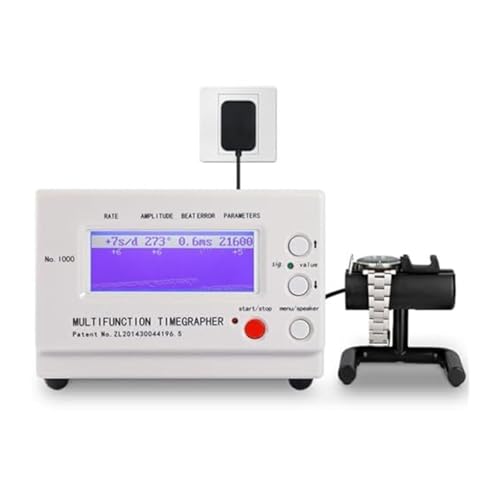
It measures frequency deviation, amplitude and heartbeat error for mechanical and automatic watches, and displays a deviation of up to ±99.9 seconds per day with a resolution of 0.1 seconds. The built-in microphone sensor captures the ticks of the clock's escape through a clip-on stand, converting the sound into a real-time frequency graph and numerical data on the LCD screen. Six preset test positions simulate marking orientations up, down, crown up, crown down, and other orientations, capturing variation in speed and amplitude at different angles of use. The LCD screen displays the amplitude histogram, beat rate graph and numerical frequency deviation side by side, continuously updating during a timing run without the need for a connected computer. Used by watch repair technicians, hobbyists and watchmaking students to check the status of the mechanical movement after maintenance, regulate daily timekeeping and checking the self-winding function before returning the watch to its owner.


 Description
(1)
Description
(1)
It measures frequency deviation, amplitude and heartbeat error for mechanical and automatic watches, and displays a deviation of up to ±99.9 seconds per day with a resolution of 0.1 seconds. The built-in microphone sensor captures the ticks of the clock's escape through a clip-on stand, converting the sound into a real-time frequency graph and numerical data on the LCD screen. Six preset test positions simulate marking orientations up, down, crown up, crown down, and other orientations, capturing variation in speed and amplitude at different angles of use. The LCD screen displays the amplitude histogram, beat rate graph and numerical frequency deviation side by side, continuously updating during a timing run without the need for a connected computer. Used by watch repair technicians, hobbyists and watchmaking students to check the status of the mechanical movement after maintenance, regulate daily timekeeping and checking the self-winding function before returning the watch to its owner.
 Product specifications
 Related products


